
Player Reviews and Complaints for LevelUp Casino Australia
 Available in AU
Short answer: current complaint records show recurring reports around withdrawal delays or cancellations, verification friction, deposit/payment disputes and support communication. Those records are useful signals, but they are not proof that every LevelUp player will have the same experience. Outcome labels matter too: the current AskGamblers complaint page contains both resolved and rejected cases, and other complaint portals use their own classification systems. The practical value is to identify where disputes tend to form, preserve evidence early and distinguish an individual complaint from a regulator finding or a universal claim about the casino.
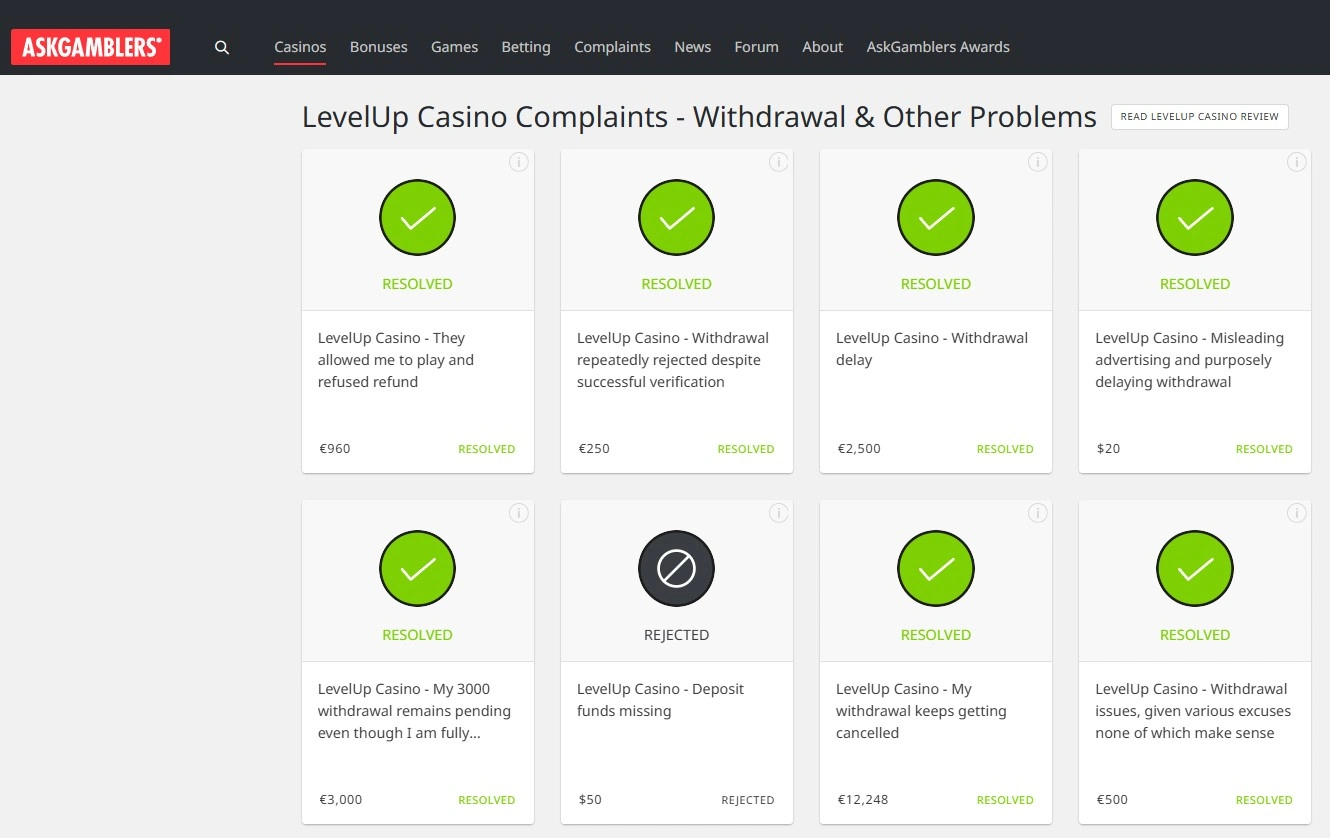
Analysis of LevelUp Withdrawal and Verification Disputes
As checked on 9 September 2026, AskGamblers has a dedicated LevelUp Casino complaint page with cases labelled Resolved and Rejected. The visible case titles repeatedly involve withdrawals, account verification, deposits and communication with support. Casino Guru’s current LevelUp page also groups complaints around delayed withdrawals, verification-related payout issues, suspended or closed accounts and disputed winnings.
These portals are secondary evidence. They document what complainants, casinos and portal moderators submitted or concluded within each portal’s process. They do not replace a regulator finding, a court decision or a complete sample of all LevelUp customers.
That is why this page uses the complaint record in two ways only: to identify recurring friction points and to show how outcomes can differ. It does not turn complaint volume into a claim of systematic non-payment or bad faith.
Four complaint themes worth watching
| Theme | What appears in documented cases | What to preserve |
|---|---|---|
| Withdrawal delay or cancellation | AskGamblers lists resolved and rejected cases involving pending, cancelled or repeatedly declined cash-outs. | Withdrawal reference, amount and currency, request time, method, status screen captures and all cancellation messages. |
| Verification friction | Some complaints connect withdrawal problems with completed or disputed identity-verification steps. | KYC request date, upload confirmation, status changes and support messages. Do not send sensitive documents to an unverified third-party address. |
| Deposit or payment mismatch | A rejected AskGamblers deposit case turned on whether the submitted payment evidence matched the disputed transaction. | Bank or wallet transaction ID, final status, merchant description, timestamp and a clean statement excerpt showing the relevant line. |
| Support communication | Several cases describe repeated contact, changing explanations or generic responses before the portal case closed. | Chat transcripts, ticket numbers, email threads and a short dated timeline of what answer was given when. |
If your issue concerns a cash-out rather than reputation research, the withdrawal guide keeps method and process questions separate from complaint interpretation.
Resolved does not mean “no problem happened”
A useful example is AskGamblers complaint #74, titled “Withdrawal repeatedly rejected despite successful verification.” The complaint described a EUR 250 withdrawal that the player said had been repeatedly rejected after verification. AskGamblers now labels that case Resolved.
Another AskGamblers case about a EUR 2,500 withdrawal delay is also labelled Resolved, with the complainant later reporting receipt of the money. A separate cancelled-withdrawal complaint is likewise shown as Resolved after the complainant stated that the bank withdrawal had arrived.
These examples show why the status column matters. A complaint can document genuine friction and still end with a resolved label. Counting only complaint titles would overstate the negative outcome; counting only the final resolution would hide the process problem that caused the complaint.
For this reason, do not read “Resolved” as a promise that a similar case will be resolved in the same way or within the same time. It is a portal status for a specific case.
Rejected does not automatically prove the casino was right
AskGamblers also shows rejected LevelUp complaints. One visible case titled “Deposit funds missing” concerns a USD 50 deposit report dated 22 November 2023. In the published discussion, the dispute turned on the payment evidence supplied to the complaint process, and AskGamblers ultimately labelled the case Rejected.
Another older case involving repeated bank-withdrawal cancellations is shown as Rejected after discussion about bank-account and statement details. The important lesson is procedural, not a verdict about every transaction: when a payment dispute depends on matching account details or proof of a completed transaction, incomplete or mismatched evidence can become decisive.
A rejected portal case is not a court judgment. It means the complaint did not proceed to a successful resolution under that portal’s process and evidence rules. Readers should inspect the case discussion before using a status label as shorthand for what happened.
How to interpret complaint counts without misleading yourself
Complaint portals are dynamic. Cases can be added, reopened, resolved or reclassified, and different portals include different subsets of users. Casino Guru’s current snapshot, for example, publishes its own distribution of open, unresolved, resolved and rejected LevelUp complaints. AskGamblers publishes a different complaint set and its own status framework.
That makes cross-site percentages a poor shortcut unless the methodology, date and population are identical. A high resolved share on one portal is not a casino-wide payout rate. A high rejected share on another is not proof that most player complaints lack merit. Each portal is a moderated dataset with selection effects.
The strongest use of complaint data is qualitative: identify repeated subjects, read the evidence and final discussion for representative cases, and note whether the portal closes the case as resolved, rejected or unresolved. Then combine that with primary facts such as licensing and regulator enforcement from the trust guide.
A documentation-first workflow for a LevelUp dispute
If something goes wrong, start building a clean record before messages and account states disappear. The goal is not to create a long narrative. It is to make the disputed event reconstructable.
- Record the transaction. Save the deposit or withdrawal amount, currency, method, request date and time, transaction ID and the status shown in the account.
- Capture status changes. Take screen captures when a withdrawal moves from pending to cancelled, or when a verification screen changes state. Include enough interface context to show which account action the image refers to.
- Keep payment-provider evidence. Save the relevant bank, card, e-wallet or blockchain reference. For bank statements, preserve the relevant line and redact unrelated transactions before sharing outside the operator’s secure process.
- Save KYC correspondence. Record what the account asked for, when you submitted it and whether the account later showed verified, pending or another state. The KYC guide explains why exact document requests should come from the live official flow.
- Preserve support contacts. Save chat transcripts, email threads, ticket references and timestamps. LevelUp’s verified support facts are 24/7 live chat and [email protected].
- Write a one-page timeline. Put each event in date order. A concise timeline is easier for support or a complaint moderator to audit than a long message mixing several issues.
- Define the requested remedy. State whether you need a withdrawal processed, a missing deposit traced, an account status explained or a specific transaction reviewed.
Never share a password, one-time login code, full card security code or cryptocurrency seed phrase in a complaint post or unsolicited message.
When support is the right first step
LevelUp currently has verified 24/7 live chat and the support email [email protected]. Live chat is useful for getting an immediate status or identifying the correct department. Email is useful when you need a durable written thread and attachments.
Keep the first contact narrow. Include the transaction reference, date, amount, method and current status, then ask one specific question. If support gives a reason for cancellation or asks for a document, record the wording and the date rather than relying on memory.
For payment-method context, use the payments guide. It separates what payment categories are supported from the separate question of how an individual dispute was handled.
Where ACMA fits, and where it does not
ACMA has documented enforcement involving Level Up Casino under Australia’s Interactive Gambling Act framework. If your concern is that a prohibited or unlicensed interactive gambling service is being provided or advertised to people in Australia, ACMA is the relevant federal regulator for that compliance issue.
That does not mean an ACMA complaint is a guaranteed route to recover an individual casino balance. ACMA investigates compliance and can take enforcement or disruption action. It should not be described as an offshore casino account-resolution service.
Keep those tracks separate. Use the operator and any documented complaint route for the personal transaction dispute. Use ACMA when the issue concerns compliance with Australia’s interactive gambling rules. If you submit both, preserve the same factual timeline so the descriptions do not contradict each other.
Reputation signals that deserve more weight
Not every online complaint carries equal evidentiary value. Give more weight to records that contain a transaction date, amount, method, screen captures or a detailed discussion, and where the portal shows how the case ended. Give less weight to one-line accusations with no context or to copied claims that cannot be tied to an identifiable case.
Also separate current facts from historical ones. A complaint from 2023 can illustrate a process issue, but it does not establish the current cashier workflow in 2026. Conversely, a current portal page can show that an old case was later resolved or rejected, which changes how the historical complaint should be described today.
For the same reason, avoid treating a complaint against a historical operator name as proof about current corporate ownership. The current LevelUp operator is Novatrix SRL, while ACMA’s 2025 Level Up Casino warning identifies Dama N.V. in that historical enforcement record.
What would make a complaint more serious?
A single delayed withdrawal is different from a case that remains unresolved after clear evidence, repeated support contacts and a completed verification process. A support misunderstanding is different from a regulator finding. A rejected complaint with mismatched evidence is different from a documented payment that both parties agree was due.
When evaluating seriousness, look for convergence:
- multiple independently documented cases involving the same operational step;
- clear transaction evidence rather than only a general accusation;
- an unresolved status after the casino has had a reasonable opportunity to respond;
- primary regulatory findings where the question is legal compliance rather than customer service;
- a current pattern, rather than several old cases quoted without their final outcome.
This approach keeps complaint research useful without turning anecdotal evidence into a defamatory universal claim.
Bottom line on LevelUp complaints
The current public complaint record contains real friction signals around withdrawals, verification, deposits and support communication. It also contains resolved and rejected outcomes, which means the record does not support a blanket claim that LevelUp never pays or that every complaint is baseless.
Use complaint portals as a case library, not a verdict generator. Read the date, disputed event, evidence discussion and final status. If you have your own issue, preserve transaction IDs, screen captures, KYC messages, emails and chat transcripts before escalating. Start with LevelUp’s verified support channels, and keep any ACMA regulatory complaint separate from the question of recovering an individual balance.
For the broader Australian regulatory picture, return to the licence and trust guide. For the full product overview, use the LevelUp Australia review.
Supported Payment Methods at LevelUp Casino Australia
Content created by the «Levelupcasinotipsau.com» team